
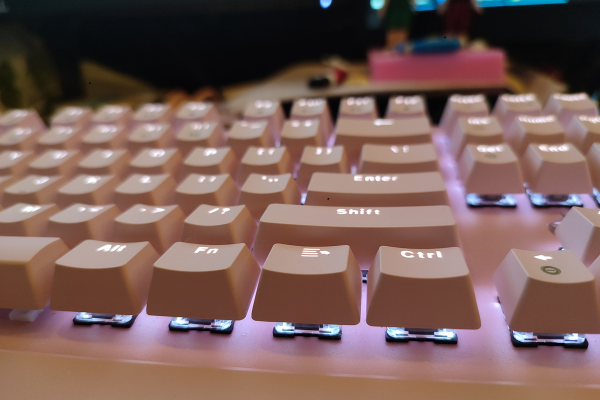
PBT good, ABS bad” is one of those phrases that gets repeated so often in keyboard communities that it starts to sound like settled fact. It isn’t quite that simple. Both materials have real strengths, and the honest answer depends more on what you’re prioritizing than on which plastic wins some abstract contest.
Let’s actually break down where each one holds up and where it doesn’t.
What These Materials Actually Are
ABS (Acrylonitrile Butadiene Styrene) and PBT (Polybutylene Terephthalate) are both injection-molded plastics, but they behave quite differently once shaped into a keycap. ABS is the material used on the vast majority of stock keyboards, it’s cheaper to produce, takes color and gloss well, and starts out feeling smooth and slightly slick to the touch. PBT is denser and has a naturally more matte, grainy surface texture, and it’s become the go-to upgrade material for people who want their keycaps to hold up over years of daily use.
Round One: Texture and Feel
This is the category where PBT has the clearest, least contested advantage. ABS keycaps develop a shiny, slippery surface on the most-used keys, usually WASD, the home row, and the spacebar, within a matter of months. Once that shine sets in, it doesn’t come back, and it genuinely changes how the keys feel under your fingers, smoother and less grippy than when they were new.
PBT resists this almost entirely. The material’s denser molecular structure means it doesn’t wear the same way, so a PBT set generally looks and feels close to day one even after years of heavy typing. If long-term feel and texture matter to you, this round goes decisively to PBT.
Round Two: Sound
Here’s where the “PBT is just better” narrative oversimplifies things. It’s true that, generally speaking, cheap ABS produces a brighter, higher-pitched sound, while cheap PBT tends to sound deeper and more muted. But this comparison only really holds when you’re comparing similarly cheap options on both sides.
High-end ABS keycaps, thick, well-manufactured, doubleshot construction, can sound genuinely excellent, sometimes rivaling budget PBT. The sound difference has as much to do with wall thickness and manufacturing quality as it does with the base material itself. A thin, cheap PBT set can actually sound thinner and more hollow than a thick, well-made ABS set, which surprises a lot of people who’ve internalized “PBT = better sound” as an absolute rule.
If you want the deepest possible sound regardless of material, the real spec to check is wall thickness (1.5mm or more is a good target), not just the material label on the listing.
Round Three: Cost
ABS keycaps are, on average, cheaper than PBT across the board, largely because the material itself is less expensive to produce and mold. That said, both materials span a huge price range. There are excellent budget PBT sets under $30, and there are premium ABS sets, particularly certain artisan and novelty designs, that cost significantly more than mid-range PBT.
Cost, in other words, tells you more about the specific manufacturer and product line than about which material you’re buying.
Round Four: RGB Compatibility
This one actually favors ABS in a specific scenario. Because ABS is naturally more translucent than PBT, it’s the material of choice for shine-through legends on RGB keyboards, where light needs to pass through the character itself to illuminate it clearly. PBT can be made translucent too, but it typically requires a specific pudding-style construction (translucent base, opaque top) to achieve a similar lighting effect, since standard PBT tends to block more light than ABS does.
If per-key RGB visibility through the legends themselves is a top priority, ABS shine-through keycaps generally deliver a cleaner, brighter effect than most PBT alternatives.
Hearing the Difference for Yourself
Written comparisons only capture so much, sound in particular is something you really have to hear rather than read about. This video does a direct sound comparison between the two materials, which makes the practical difference much clearer than any description:
Listening to a comparison like this before buying helped me realize the material label alone wasn’t telling me nearly as much as I’d assumed.
So Which Should You Actually Buy?
If you’re building a keyboard for long-term daily use and want it to look and feel the same in three years as it does today, PBT is the safer, more durable choice, and it’s what most enthusiasts settle on for exactly that reason. Our budget-friendly PBT keycap roundup covers solid options if you’re going this route without overspending.
If your priority is vibrant RGB shine-through, a specific color or novelty design that’s only available in ABS, or you simply don’t type enough for the shine issue to bother you, ABS remains a completely valid choice, and modern high-quality ABS sets have closed a lot of the sound gap that used to separate the two materials.
Neither material is objectively “correct.” The right choice depends on whether you’re optimizing for long-term texture and durability, sound depth on a budget, or lighting visibility, and once you know which of those actually matters most to you, the decision becomes a lot more straightforward than the “PBT good, ABS bad” shorthand suggests.
One Thing Both Materials Share
Regardless of which you choose, keycap profile (the shape and height of the keys, covered in our guide to keycap profiles) has just as much impact on your typing feel as the material does, arguably more for some people. Material affects texture, sound, and durability; profile affects how your fingers actually travel across the board. It’s worth thinking about both together rather than fixating on material alone.