
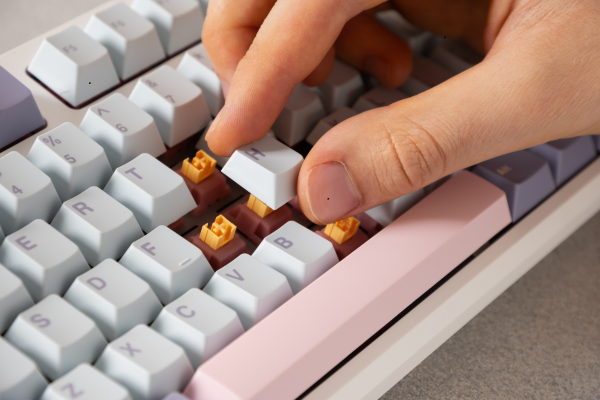
$50 keyboard kit” was the search that got me into this hobby, and it was also the search that lied to me the most. Not maliciously, the kit really was $50. Nobody mentioned that a usable keyboard needed switches, keycaps, and a cable on top of that. My actual total came out closer to $140, and I remember being genuinely annoyed that nobody had just told me the real number upfront.
So here’s the real number, broken down honestly.
The Core Cost Breakdown
| Component | Budget Tier | Mid Tier | Premium Tier |
|---|---|---|---|
| Barebones kit (case, plate, PCB) | $40-60 | $80-150 | $200-400+ |
| Switches (full set) | $15-25 | $25-45 | $45-100+ |
| Keycaps (full set) | $20-35 | $35-70 | $80-200+ |
| Cable | $5-10 | $15-30 | $40-80 |
| Tools (if not included) | $10-20 | $10-20 | $10-20 |
Add it up, and a genuinely decent first build lands somewhere between $90 and $150 at the budget end, climbing well past $300 once you start caring about aluminum cases and premium keycap sets.
Why the Kit Price Is Only Part of the Story
Barebones kits are, deliberately, priced as just the foundation. That’s the whole point of the “barebones” label, it’s an incomplete product by design, meant for you to finish with your own switch and keycap choices. Marketing tends to lean on that low headline number without always making clear what’s missing, which is exactly how I got surprised on my first purchase.
This isn’t a hidden fee or a scam, to be clear. It’s just a structural quirk of how this hobby is priced, and one that trips up nearly every newcomer at least once.
Where the Money Actually Goes
Switches are cheap individually, often $0.20-$0.60 each, but they add up across a full keyboard. A 65-key board needs, unsurprisingly, 65 switches, so even budget options land in the $15-25 range for a full set, and premium enthusiast switches can push that closer to $80-100.
Keycaps vary the most of any component. A basic PBT set runs $20-35, while premium doubleshot sets with unique colorways or novelty artisan caps can run into the hundreds. This is genuinely the component where personal taste drives cost the most, and where beginners can save the most money without sacrificing much, since even inexpensive PBT sets sound and feel decent.
The case itself scales heavily with material. Plastic cases keep costs down substantially, aluminum adds a real premium for both material and machining, and specialty materials (polycarbonate, brass weights, etc.) push things further still.
A Realistic First-Build Budget
Watching a full cost breakdown video before your first purchase helps a lot here, since it’s easy to underestimate the “extras” when you’re just staring at a single kit’s listing price:
For a first build, I’d genuinely budget around $100-150 total if you’re being cost-conscious, and treat anything cheaper as likely missing a component you’ll need to add later anyway.
Hidden Costs People Forget
A few smaller expenses that regularly catch beginners off guard:
- Shipping, especially if switches, keycaps, and the kit come from different vendors. Three separate shipping charges can add $15-20 to a build that looked cheaper on paper.
- A USB cable, which some kits assume you already own (you might not, especially if your old keyboard used a different connector).
- Extra switches, since it’s wise to order a handful more than your exact key count in case of a dead one or an accidental pin bend during installation.
- Tools, if your kit doesn’t include a keycap puller or switch puller, which is more common on ultra-budget kits than people expect.
Is It Actually Cheaper Than Buying Pre-Built?
Not usually, at least not at the entry level. A quality pre-built hot-swap keyboard can be found for $60-100 total, fully assembled, no separate switch or keycap shopping required. A barebones custom build at a comparable quality level typically comes out a bit more expensive once every piece is accounted for.
The value proposition of building your own isn’t really about saving money, it’s about getting exactly the combination of feel, sound, and aesthetics you want, which a pre-built board simply can’t match regardless of price. If cost alone is your priority, pre-built is usually the better deal; if customization matters more to you, the premium for a custom build is generally worth paying.
If you’re leaning toward saving money on your first build, our budget-friendly silent switches under $30 roundup is a good place to trim the switch line item specifically, and our barebones vs. pre-built comparison goes deeper into that value tradeoff if you’re still on the fence about which route fits your budget better.
The Honest Bottom Line
Budget $100-150 for a modest but genuinely satisfying first build, and don’t be surprised if your actual total comes in a bit above whatever the kit’s sticker price suggested. That gap between the headline number and the real total is normal in this hobby, not a sign you’re doing something wrong or overspending.